How to Plan a Whole-School Space Day Without Adding to Teacher Workload
An exciting Space Day can sound like one more thing for teachers to organise: an assembly to write, activities to source, resources to print and parents to contact. It needn't be a production. Give the whole school one simple mission, let each class explore it at an appropriate level, and keep the shared parts of the day short.
This plan gives you a timetable, a small set of staff roles, a ready-to-use assembly idea and a parent message you can adapt. The Science Gadget Shop is an optional addition if your school also wants a fundraising event.
World Space Week runs 4–10 October each year. In 2026, its theme is Rocket Revolution, so a paper-rocket design challenge is a natural starting point. Pick any school day that suits your timetable: you do not need to rearrange an entire week to take part. World Space Week UK has details of this year's theme.
Start with one question, not six different projects
Use a question every class can answer: How could we make a rocket travel further? Younger children can make, try and describe. Older pupils can change one feature, measure a result and explain their thinking. The school gets a shared experience, while teachers can work within their usual lesson structure.
If your school is short on time, the essentials are one launch assembly, one classroom activity and a five-minute celebration at the end. Everything else is optional.
A sample Space Day timetable
Adjust the times around your normal breaks, lunch and assemblies. Classes can do their investigations in their own rooms; a hall takeover is not required.
Time | What happens | Preparation |
8:45–9:00 | Put shared materials where classes can collect them. | One central box per year group. |
9:00–9:15 | Whole-school launch assembly. | One adult leads; use the short script below. |
9:15–10:15 | Class challenge: design a paper rocket. | Paper, tape, straws and a simple recording sheet if wanted. |
10:15–10:45 | Usual break. | None. |
10:45–11:45 | Test, change one thing and try again. | A clear test area and a tape measure for older pupils. |
11:45–12:00 | Talk about what changed and why. | One sentence or drawing per pupil is enough. |
Afternoon | Continue normal lessons or add one space-themed choice. | Optional; see ideas below. |
2:45–3:00 | Share a few discoveries in classrooms or a brief gathering. | Ask each class for one observation. |
After school or at an agreed time | Optional Science Gadget Shop. | Arrange sales and supervision separately from lessons. |
Shorter version: Run the assembly, give each class a 45-minute investigation, then invite one takeaway from each class. That is still a Space Day.
Give adults small, clear jobs
The organiser only needs to send one brief message to colleagues. Keep responsibilities visible so the day does not quietly land on the Science Lead.
Role | One clear job |
Science Lead or organiser | Choose the date, share this timetable and name the one core activity. |
Assembly lead | Introduce the mission and explain how pupils will test their ideas. |
Class teachers | Run or adapt the challenge for their own pupils; choose a suitable test space. |
School office | Send one parent message if the school wants to publicise the day. |
PTA or volunteers, if involved | Organise an optional Gadget Shop under the school's normal arrangements. |
One preparation email can cover the date, assembly time, materials, testing area and who to contact. Teachers do not need matching displays or elaborate costumes.
A two-minute launch assembly you can use
Hold up a folded paper rocket or show a simple picture of one, then say:
“This week, people around the world are celebrating World Space Week. Our mission today is to think like engineers. We will make a rocket, test it, change one part and find out what happens. Some rockets may travel further than others. That is useful: a surprising result gives us something to investigate. By the end of the day, I want every class to be able to tell us one thing they discovered.”
Ask pupils: “What might affect how far a paper rocket travels?” Take three suggestions. Finish by reminding them that the aim is to test an idea, not to make the most beautiful rocket.
For younger pupils, a picture of a rocket and a single question will do. There is no need for a presentation or a visiting speaker.
One activity, adapted for different ages
The paper-rocket challenge
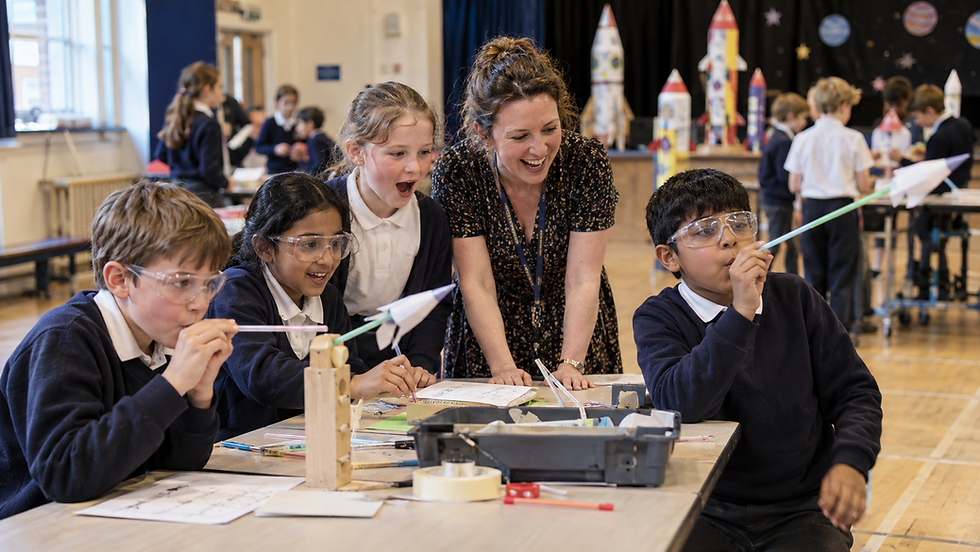
Provide paper, tape and individual drinking straws. Pupils roll a small paper tube that fits over a straw, close one end to make a nose and add paper fins if they wish. They launch by blowing through their own straw in a designated direction.
An adult should check the design and set a clear launch line. Do not share straws; keep launches away from faces and follow your school's usual risk assessment and hygiene arrangements. If straw launching does not suit a class, use a paper rocket design and discussion activity instead.
Reception and Key Stage 1: Make a rocket, describe what happened and choose one change to try. “What did you notice?” is enough.
Lower Key Stage 2: Try two fin shapes or two nose designs. Mark where each rocket lands and compare distances.
Upper Key Stage 2: Keep the launch position and method consistent, change just one design feature, repeat trials and record the results. Ask whether the evidence supports the prediction.
The investigation is about asking a question, testing and improving. A paper rocket does not need to model a real launch accurately to make the scientific thinking worthwhile.
Optional afternoon choices: draw a mission patch and explain its symbols; write a short “message from mission control”; design a landing vehicle from scrap paper and discuss how to protect its passenger; or compare the different rocket designs tested by the class. Choose one if it fits the timetable.
For ready-made curriculum-linked space materials, ESERO-UK's free primary resources offer further ideas. You can use those another day instead of creating extra lessons for this event.
A parent message you can copy and adapt
Subject: Our school Space Day – [date]Dear parents and carers,On [date], our pupils will be taking part in a whole-school Space Day. Each class will explore a simple rocket-design challenge, testing ideas and sharing what they discover. The activities will take place during the normal school day, and children do not need to bring anything from home.[Optional: We will also hold a Science Gadget Shop at [time and place]. If your child would like to buy anything, we will send prices and payment details separately. Taking part in Space Day does not depend on making a purchase.]We are looking forward to a day full of questions, ideas and discoveries![School name]
The school office can send this once the date is set. If you are not running a shop, delete the optional paragraph and you are done.
Want to add a school fundraiser? Keep it separate and simple
A Science Gadget Shop can be a lively finish to the day, but it does not need to carry the teaching. Run the rocket challenge for every child during lessons; offer the shop at an agreed break, collection time or after school. That way, buying something remains optional.
Inspire Science Education supplies a range of science products alongside posters, parent-letter templates, price lists and guidance for running the shop. Some products connect naturally to flying, forces, light or discovery; the Science Gadget Shop is a broad science range, not an all-space assortment. A school team or PTA can use the supplied materials to organise the sales. Choose a kit based on the number of pupils taking part, then check the current product page for its contents and price.
If you are planning an event, explore the Science Gadget Shop kits or download the information pack. Schools or PTAs are invoiced when an order is placed, with payment normally due within 30 days; see the current order terms for details.
The five-minute planning checklist
Choose the date and decide whether you want the full timetable or the short version.
Share the assembly script and the one core classroom challenge with staff.
Put paper, tape, individual straws and any measuring tools in central boxes.
Agree where and how rockets will be tested under your usual school procedures.
Ask the office to send the parent message; add shop details only if relevant.
A successful Space Day is one where pupils get to wonder, make, test and talk about what happened. Give them that shared mission, and the day can feel special without adding a new planning project for every teacher.