“I’m Not Good at Science”: Helping Primary Pupils Build Confidence
“I’m not good at science.”
When a child says this, it is worth finding out which part feels difficult. Perhaps the vocabulary is unfamiliar. Perhaps they understand the idea but struggle to explain it. They may be worried about giving an incorrect answer in front of the class.
Building science confidence in primary schools starts with understanding those barriers and giving pupils a clear way to participate.
Here are some practical approaches to try during your everyday lessons.
Start with something pupils can observe
Give children something specific to look at before asking them to explain it.
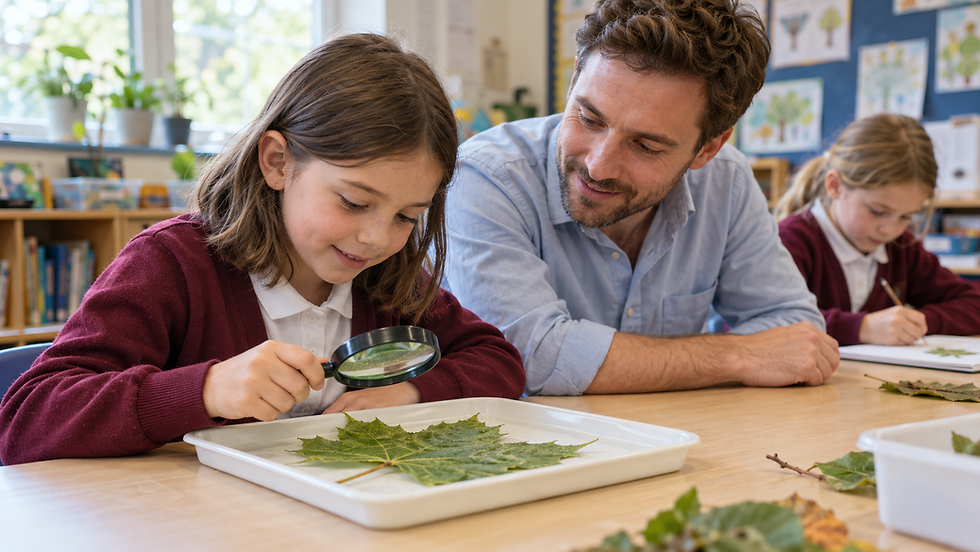
Place two different leaves on a table. Show a melting ice cube. Let pupils examine a collection of everyday materials.
Begin with a question such as:
“What do you notice?”
Allow time for children to look closely. A pupil might notice a jagged edge, a change in shape or a difference in texture. These observations give you something concrete to build on when introducing the scientific explanation.
For a child who is unsure where to begin, narrow the question further: “Look at the edges of these two leaves. What is different?”
The next step becomes clear enough to attempt.
Teach the language pupils need
A child may have an idea without yet having the words to communicate it.
Choose the scientific vocabulary needed for the lesson and teach it directly.
Explain each word, demonstrate its meaning where possible and use it again throughout the activity.
For example:
Observe: Look carefully and notice details.
Prediction: An idea about what might happen, based on what you already know.
Absorbent: Able to soak up liquid.
The Education Endowment Foundation’s Improving Primary Science guidance recommends explicitly teaching scientific vocabulary and giving pupils repeated opportunities to use it.
A short word bank, a labelled example or a sentence starter can support children as they practise. Return to the words in later lessons so pupils have opportunities to use them with increasing independence.
Give children time to rehearse an idea
Answering immediately in front of a whole class can feel demanding.
Before inviting responses, give pupils a moment to think and an opportunity to explain their idea to a partner. You could ask them to point to the evidence or make a quick sketch first.
Useful prompts include:
“I noticed…”
“I think this happened because…”
“The result makes me think…”
Listen while pupils talk. You may hear a thoughtful explanation from a child who rarely volunteers an answer.
You can then help them develop it: “You noticed that the fabric became wet. Which word from our lesson could help you describe that?”
Allow different ways to show understanding
Consider what you are assessing in the lesson.
If the aim is to understand how a circuit works, a pupil might demonstrate their understanding by identifying a gap and explaining what needs to change. A lengthy written account may introduce an additional difficulty.
Depending on the learning goal, children could:
Explain their thinking aloud.
Draw and label a diagram.
Demonstrate using the equipment.
Arrange pictures into a sequence.
Complete a short explanation with suitable support.
Writing remains an important part of science. These options help you see what pupils understand while you continue to develop their ability to record and explain it in writing.
Make participation clear during group work
Practical work can become frustrating if one child takes charge of all the equipment.
Give pupils clear responsibilities and rotate them. One child might measure, another record a result and another check that the agreed method is being followed.
Keep the scientific thinking shared. Everyone should have an opportunity to predict, observe and discuss what the results suggest.
A pupil who begins by managing the equipment should also get a turn to measure or explain. Use support where needed, then gradually reduce it as children become more familiar with the task.
Respond thoughtfully to unexpected results
A prediction that does not match the result gives pupils something to examine.
Ask:
“What did we expect, and what did we actually observe?”
Then help children consider what the evidence suggests. Does their explanation need to change? Was the test carried out consistently? Would repeating it help?
Be clear about misconceptions and teach the correct scientific ideas. At the same time, show pupils how an initial explanation can develop when they have more information.
For example: “You predicted that every metal object would be attracted to the magnet. Let’s look at which objects were attracted and identify what they are made from.”
The pupil has a useful next step.
Make progress specific
Tell children which part of their scientific work has improved.
You might say:
“You checked the measurement again before recording it.”
“You used the word ‘transparent’ and explained what it meant.”
“Your drawing includes a detail you noticed through the magnifying glass.”
Specific feedback helps pupils recognise what they did successfully and what they can repeat next time.
You can also return to earlier work. Ask children to compare their first explanation with their latest one and identify something they now understand more clearly.
Give curiosity room beyond the lesson
Children’s interests can provide useful starting points for science conversations.
A football, a pet, a puddle or a favourite gadget might prompt a question worth exploring. Ask pupils what they would like to understand, then connect suitable questions to the science you are teaching.
At Inspire Science Education, our Science Gadget Shop gives schools another opportunity to introduce children to science-themed gadgets and activities.
We supply the products alongside posters, parent-letter templates, price lists and event guidance. Your school or PTA can run the shop as a fundraising event, with purchases optional.
During your next science lesson, notice a pupil who seems reluctant to begin. Find out which part feels difficult, offer one clear next step and give them time to explain what they discover.