World Science Day 20265 Easy Ideas for Primary Schools
World Science Day 2026 takes place on Tuesday 10 November. For primary schools, it is a useful opportunity to give children time to investigate something together and share what they find out.
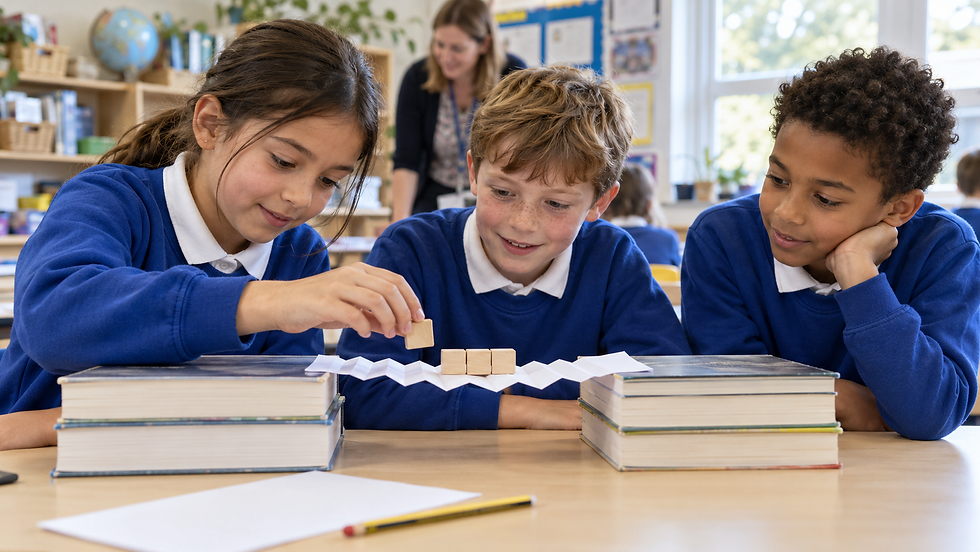
A sheet of paper, two piles of books and a few counting cubes can be enough to get started. Will the paper hold the cubes? Would folding it help? Why did another group get a different result?
Here are five World Science Day ideas for primary schools, using familiar classroom resources. Choose one that fits your pupils and the time you have available.
The World Science Day 2026 theme
UNESCO’s World Science Day for Peace and Development highlights the role of science in our lives. The 2026 theme is “Common ground through science diplomacy”.
For a primary classroom, one way to explore this theme is to focus on cooperation: listening to another person’s idea, comparing evidence and sharing something useful. The activities below give children opportunities to practise those habits.
1 Build a paper bridge together
You will need: A4 paper, two low stacks of books and identical small counting cubes.
Place the books about 15 cm apart and lay a sheet of paper across the gap. Add cubes gently near the centre, one at a time, and see how many it supports. Then try a fresh sheet of the same paper folded into a concertina, with the ridges running between the supports.
Keep the gap, cube size and loading position the same. Ask pupils to compare the results and suggest why changing the paper’s shape affected the bridge.
Younger children can count and describe what happened. Older pupils can repeat each design with fresh sheets and discuss how consistent the results are. Invite groups to share a useful design tip before trying again.
2 Investigate how far a toy car travels
You will need: A toy car, a rigid ramp, books, a measuring tape and different landing surfaces such as smooth card and fabric.
Set up a low ramp and place one surface at its foot. Release the car from a marked point without pushing it. Measure how far it travels from the bottom of the ramp before stopping, using the same point on the car each time.
Change the landing surface and try again. Keep the car, ramp height and release point the same. Older pupils can repeat each test three times; younger children can mark and compare stopping positions.
Before revealing another group’s results, ask: “What would they need to know to repeat our test?” This gives pupils a practical reason to explain their method clearly.
3 Sort the same materials in different ways
You will need: A tray of safe everyday materials, such as paper, card, fabric, foil and a wooden block.
Ask each group to choose a property and use it to sort the objects. They might group them by whether they bend, feel smooth or let light through. Encourage children to name the material as well as the object.
Swap trays with another group and invite pupils to work out the sorting rule. Can the same collection be sorted in a different useful way?
Younger pupils can explain by pointing or demonstrating. Older pupils can make a branching key using yes-or-no questions. Comparing the different groupings shows why scientists need to explain the criteria they use.
4 Go on an everyday science hunt
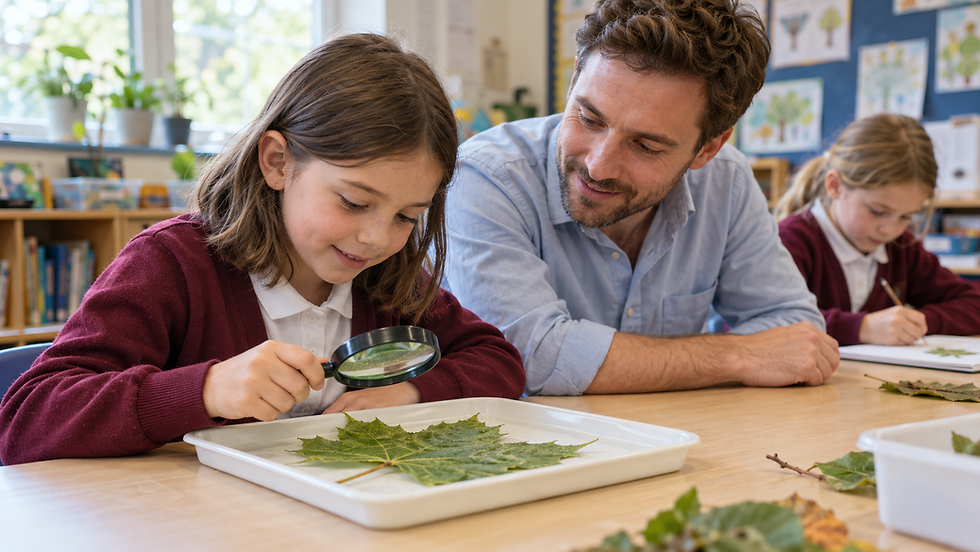
Take a short walk around the school and ask pairs to spot something they would like to investigate. A puddle, a plant leaning towards a window or the wheels on a trolley could all prompt a question.
Help pupils turn an observation into something specific: “Will this puddle still be here tomorrow?” or “Does the trolley move equally easily on different surfaces?”
Back in class, collect the questions and choose one to revisit. Younger children can draw what they noticed; older pupils can suggest what evidence would help answer their question. Some questions will need observation over several days or information from a book.
5 Share one discovery with another class
Give each group a simple invitation: show another class something you found out. They could demonstrate their bridge, share their car measurements or explain a surprising way to sort the materials.
Use three prompts: “We wanted to find out…”, “We noticed…” and “Our evidence was…”. A drawing with labels, a short explanation or an adult recording a pupil’s words can all work.
Ask the visiting class to contribute one question. If it reveals something nobody tested, keep it for the next science lesson. World Science Day can leave pupils with a reason to continue investigating.
Fit it into one lesson
For a 30-minute celebration, allow five minutes to introduce the question, twenty minutes for one activity and five minutes to share a discovery. Choose materials and group roles to suit your pupils, demonstrate the steps and allow children to explain their thinking in different ways. Follow your usual school arrangements for practical work.
Add a Science Gadget Shop to your celebration
If you would like to extend the event and raise funds for your school, our Science Gadget Shop provides science products to sell alongside posters, parent-letter templates, price lists and event guidance. Staff or PTA volunteers can run the shop at a time that suits your school.
Keep the classroom activities open to every pupil, with purchases optional. Choose a kit for the number of children likely to visit and check our Profit Protection Guarantee conditions when planning your event.
Explore the Science Gadget Shop kits, then choose your kit and order online for your World Science Day celebration.
Read the Profit Protection Guarantee conditions. For more classroom support, explore our free primary science resource collection.