World Space Week Ideas for Primary Schools

World Space Week is a brilliant opportunity to bring space, science and STEM learning to life across a primary school.
Held every year from 4th to 10th October, World Space Week is an international celebration of science and technology. For schools, it is a perfect chance to create excitement around space, rockets, planets, astronauts, engineering, discovery and the future of science.
The good news is that World Space Week does not need to be complicated.
A successful space-themed week can be built around simple classroom activities, creative challenges, assemblies, displays, practical investigations and whole-school events. Whether you are a Science Lead planning something for the whole school or a class teacher looking for a few easy ideas, there are plenty of ways to make World Space Week memorable for pupils.
Here are some World Space Week ideas for primary schools.
1. Launch a Whole-School Space Assembly (World Space Week Ideas)
A World Space Week assembly is a great way to start the week.
You could introduce pupils to the idea of space exploration, famous astronauts, rockets, satellites, planets and why space science matters. Keep it visual, exciting and age-appropriate.
You could include:
Amazing space facts
A short video clip or image of a rocket launch
Questions about planets and the solar system
A quick quiz
A challenge for pupils to complete during the week
The aim is to create a sense of excitement and make children feel that something special is happening across the school.
2. Create a Space Display
A space display can make the whole school feel part of World Space Week.
Classes could contribute planets, rockets, astronaut writing, moon facts, constellation artwork or science vocabulary. A shared display in a hall or corridor can help celebrate pupil work and build interest throughout the week.
Display ideas could include:
Our Solar System
Mission to Mars
Famous Astronauts
Space Vocabulary
Women in Space
Rockets and Spacecraft
Life on the International Space Station
This is also a lovely way to involve different year groups.
3. Run a Rocket Challenge
Rockets are always a favourite with pupils.
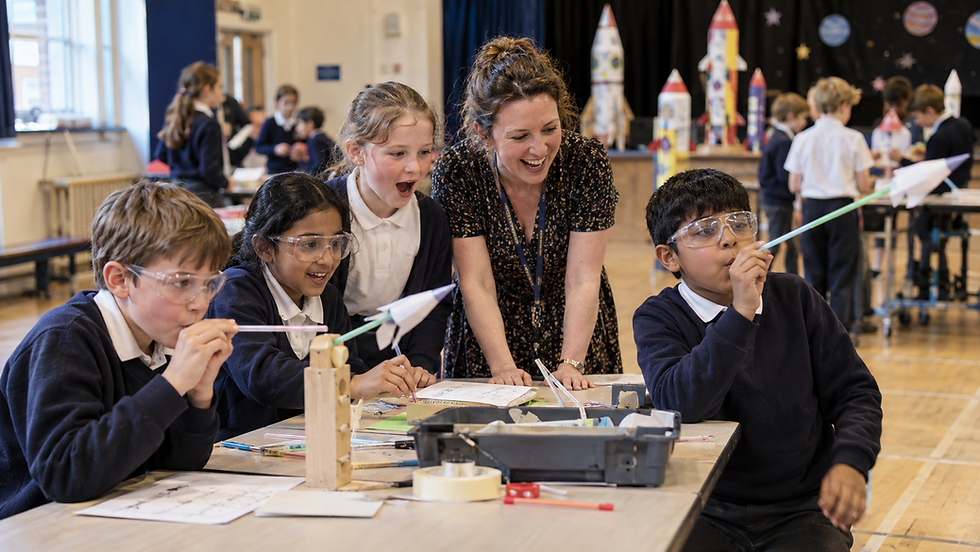
A simple rocket challenge can be adapted for different ages. Younger pupils might make straw rockets or paper rockets, while older pupils could investigate how changing the rocket design affects distance, accuracy or flight path.
Children can explore:
Forces
Air resistance
Direction
Fair testing
Measuring distance
Improving a design
This type of activity feels exciting, but it also gives pupils a real opportunity to think scientifically.
4. Design a Moon Base
A moon base design challenge is a fantastic activity for encouraging creativity and problem-solving.
Ask pupils to imagine that humans are going to live on the Moon. What would they need to survive? How would they get food, water, oxygen, power and protection?
Pupils could draw, label or build their moon base using recycled materials.
This activity can link to:
Materials
Habitats
Forces
Energy
Design and technology
Writing and speaking skills
It also encourages children to think like scientists and engineers.
5. Explore the Solar System
World Space Week is a great time to revisit the planets and our place in space.
Children could create planet fact files, make scale models, order the planets, compare sizes or investigate how long each planet takes to orbit the Sun.
You could also ask pupils to choose one planet and present it to the class.
Useful questions include:
Which planet is closest to the Sun?
Which planet is the largest?
Why is Earth suitable for life?
What makes Mars interesting to scientists?
Why is space exploration important?
This works well as a science, writing or homework task.
6. Hold a Space Reading Session
Space is a brilliant theme for reading.
You could choose fiction and non-fiction texts linked to astronauts, planets, rockets, aliens, space travel or the Moon. Pupils could read extracts, answer comprehension questions, write book reviews or create their own space-themed stories.
Space reading activities are especially useful because they allow schools to link
World Space Week with literacy.
Ideas include:
Astronaut diary entries
Rocket launch news reports
Planet fact sheets
Alien encounter stories
Mission logs
Space poetry
This helps World Space Week feel cross-curricular rather than just a science event.
7. Run a Space Gadget Shop
A Space Gadget Shop can turn World Space Week into a memorable whole-school event.
Children can explore space-themed products, help promote the event, take part in pupil enterprise activities and enjoy a special science-focused experience in school.
A Space Gadget Shop can work well because it combines:
Space excitement
Pupil engagement
Enterprise learning
Fundraising potential
A ready-to-run event structure
It can be used as the main World Space Week event or as part of a wider week of activities.
8. Create a Space STEM Challenge Day
A STEM challenge day can make World Space Week feel practical and hands-on.
Each class could complete a different space-themed challenge. For example:
Build a straw rocket
Design a Mars rover
Make a moon lander
Create a parachute for a space capsule
Build a satellite model
Design a space suit
Make a constellation viewer
These activities encourage teamwork, creativity and problem-solving.
They also help pupils see that science is not just about remembering facts. It is also about testing ideas, improving designs and solving real problems.
9. Learn About Famous Space Scientists and Astronauts
World Space Week is a good opportunity to introduce pupils to people who have helped us understand space.
You could focus on astronauts, engineers, mathematicians, scientists and space communicators.
Possible people to explore include:
Mae Jemison
Tim Peake
Katherine Johnson
Maggie Aderin-Pocock
Neil Armstrong
Valentina Tereshkova
Helen Sharman
Pupils could create posters, timelines, fact files or short presentations.
This helps children see that science is carried out by real people and that there are many different careers linked to space.
10. Make Constellation Art
Constellation art is a simple activity that works particularly well with younger pupils.
Children can learn about star patterns, then create their own constellations using black card, chalk, stickers, paint, split pins or simple hole-punch designs.
They could:
Recreate a real constellation
Invent their own constellation
Write a myth or story about it
Label the stars
Display the finished artwork
This links science, art and storytelling beautifully.
11. Run a Space Quiz
A space quiz is a simple way to create excitement during World Space Week.
You could run it in class, during assembly, in houses or as a lunchtime activity.
Questions could cover:
Planets
The Moon
Rockets
Astronauts
The Sun
Space exploration
Space facts
A quiz works well because it is easy to organise and can be adapted for different year groups.
12. Set a Whole-School Space Challenge
To make World Space Week feel bigger, set one challenge that the whole school can take part in.
For example:
Design a mission badge
Create a rocket poster
Write a message to an astronaut
Invent a new planet
Build a recycled spacecraft
Create a space fact file
Design a space-themed invention
This gives every pupil a way to get involved, even if each class is doing different activities.
Tips for Planning World Space Week
World Space Week does not have to take over the whole timetable.
A successful week might include one assembly, one class activity, one display and one special event. The key is to keep it manageable.
Here are a few simple tips:
Plan early so staff know what is happening.
Keep activities simple and age-appropriate.
Use ready-made resources where possible.
Link activities to science, writing, art and design.
Give pupils something to make, test, design or present.
Create a display so the week feels visible.
Use the week to build enthusiasm for science across the school.
It is better to do a few things well than to create a complicated plan that becomes difficult to manage.
Free Space Resources for Primary Schools
If you are planning World Space Week, you do not need to start from scratch.
Inside our Member’s Hub, we provide free space-themed resources for primary schools, including activities, posters, investigations, writing tasks and other materials designed to support busy teachers and Science Leads.
You can access the free space resources here:
These resources are designed to save time and help schools create exciting, practical and memorable space learning.
Make World Space Week Memorable
World Space Week is a wonderful chance to show children that science is exciting, creative and full of possibility.
Whether pupils are launching rockets, designing moon bases, learning about astronauts or exploring the solar system, the most important thing is that they feel curious and involved.
With a few well-chosen activities, World Space Week can become a highlight of the school year and a powerful way to inspire the next generation of scientists, engineers, explorers and problem-solvers.