World Space Week 2026: 8 “Rocket Revolution” Activities for Primary Schools
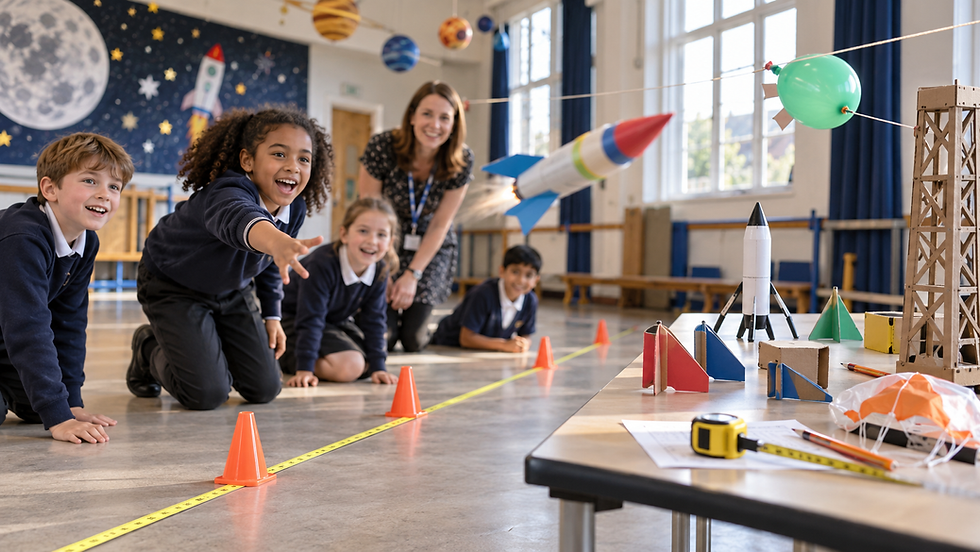
World Space Week takes place from 4 to 10 October each year, bringing schools and organisations around the world together to celebrate space science and technology.
The theme for World Space Week 2026 is Rocket Revolution.
The theme explores how rocket technology is changing -from reusable launch systems and smaller rockets to new organisations gaining access to space. For primary schools, it provides a brilliant opportunity to investigate forces, materials, engineering, fair testing and problem-solving.
You don’t need expensive equipment or an entire week of complicated lessons. Here are eight manageable activities that can help bring the Rocket Revolution to life in your primary school.
1. Make and Launch Straw Rockets during World Space Week 2026 rocket activities
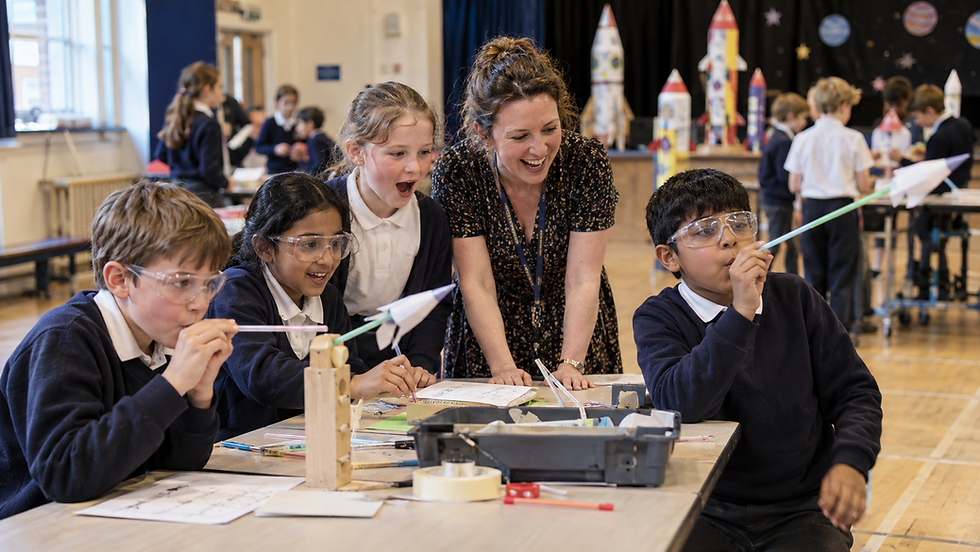
Straw rockets are one of the quickest and simplest ways to introduce children to rocket design.
Roll a small piece of paper around a pencil to create a narrow tube. Tape the tube closed at the top, add paper fins and decorate it before sliding it off the pencil. Place the finished rocket over a drinking straw and blow through the straw to launch it.
Children can investigate:
Rocket length
Nose-cone shape
Number of fins
Fin size
Distance travelled
Encourage children to predict which design will travel furthest before testing their ideas.
Science link: Forces, air pressure, measuring and comparative testing.
2. Create Balloon Rockets
Thread a drinking straw onto a long piece of string and attach the string securely across the classroom or hall.
Inflate a balloon without tying it, then tape it to the straw. When the balloon is released, escaping air pushes it along the string.
Children could compare different balloon sizes or investigate whether adding a small paper payload changes how far or how quickly the balloon travels.
This is an exciting way to demonstrate that forces act in opposite directions during a rocket launch.
Science link: Forces, movement, air and simple comparative testing.
Remember to check for latex allergies and use suitable alternatives where necessary.
World Space Week 2026 rocket activities are awesome!
3. Investigate the Best Launch Angle
Does a rocket travel furthest when launched straight upwards, horizontally or somewhere in between?
Children can use their paper straw rockets to investigate different launch angles. Test each rocket at several angles, such as 30, 45 and 60 degrees, and measure the horizontal distance travelled.
Older pupils can repeat each test several times and calculate an average result.
Discuss how to make the investigation fair. Children should keep the rocket design, launching position and person launching it the same while changing only the angle.
Science link: Forces, measurement, fair testing and interpreting results.
4. Design the Most Effective Rocket Fins
Rocket fins help keep a rocket stable as it travels through the air—but what makes an effective fin?
Provide children with identical paper rocket bodies and challenge them to alter the fins. They could investigate:
Two, three or four fins
Large or small fins
Rounded or pointed fins
Different fin positions
Children should change only one feature at a time and compare how straight, far or smoothly each rocket travels.
Ask them to explain their design choices and use their results to create an improved final rocket.
Science link: Aerodynamics, stability, fair testing and evaluating designs.
5. Complete a Reusable Rocket Landing Challenge
Modern reusable rockets are designed to return safely so that parts can be used again.
Challenge children to create a model rocket that can survive repeated landings. Use lightweight materials such as cardboard tubes, paper cups, card, straws and masking tape.
Children could add landing legs, padding or a small parachute. Test each design by dropping it from the same safe, adult-controlled height onto a marked landing area.
Can the rocket land upright? Does it remain undamaged? Can it be launched—or dropped—again?
Encourage children to test, improve and retest their designs.
Science link: Materials, forces, engineering and sustainability.
6. Protect a Rocket’s Payload
Rockets carry important payloads into space, including satellites, scientific instruments and supplies.
Give each group a small model payload, such as a wooden cube, pom-pom astronaut or small plastic counter. Their challenge is to build a lightweight capsule that protects it during landing.
Children might use paper, card, cotton wool, fabric or reusable packaging materials.
Drop each capsule from the same safe height and inspect the payload. Which materials provided the best protection? Did adding more protection make the capsule heavier?
Science link: Properties of materials, impact forces and design decisions.
7. Build a Rocket Launch Tower
A rocket needs much more than an engine. Launches also rely on towers, platforms and carefully designed infrastructure.
Using card, paper straws, tape and recycled materials, challenge teams to construct a launch tower capable of supporting an empty model rocket.
The tower must:
Stand independently
Hold the rocket securely
Provide space around the rocket
Remain stable during a countdown
Children could also identify where engineers, equipment and safety teams would be positioned.
This activity demonstrates that successful space missions depend on collaboration between many different people—not only astronauts.
Science link: Structures, stability, engineering and teamwork.
8. Run a Whole-School Rocket Revolution Challenge
Bring different year groups together by creating one shared whole-school mission.
Each class could complete an age-appropriate element:
EYFS and KS1: Design and decorate a new rocket.
Lower KS2: Investigate fins and rocket stability.
Upper KS2: Explore launch angles or reusable landing systems.
Whole school: Display the designs and celebrate the different solutions.
Finish with a supervised launch event or Rocket Revolution assembly. Awards could recognise teamwork, scientific thinking, creativity, sustainability and the most improved design—not simply the rocket that travels furthest.
This creates a shared sense of excitement while keeping the activities manageable for individual teachers.
Keep Rocket Activities Safe
Always use lightweight paper or foam rockets and establish a clear launching area.
Children should never aim rockets at another person. Avoid sharp components, supervise all launches and follow your school’s normal risk-assessment procedures.
Activities can be adapted to suit the age, needs and abilities of your pupils.
Inspire Your Young Rocket Scientists
World Space Week doesn’t need to involve an overcrowded timetable or hours of additional preparation.
Choose two or three activities, give children time to test and improve their ideas, and celebrate the scientific thinking behind their designs.
The important outcome is not creating the perfect rocket. It is inspiring children to ask questions, solve problems and recognise that engineering develops through testing, failure and improvement.
For more inspiration, explore our guide to World Space Week ideas for primary schools.
At Inspire Science Education, our ready-to-run Space Gadget Shops help schools create exciting whole-school space experiences with minimal preparation.
We provide the space gadgets, posters, price lists, parent-letter templates and straightforward guidance needed to run your event. Children continue their exploration at home, while your school can also raise valuable funds for future learning.
Make World Space Week 2026 an experience your pupils will remember.